Industeam moves from cross-border to international
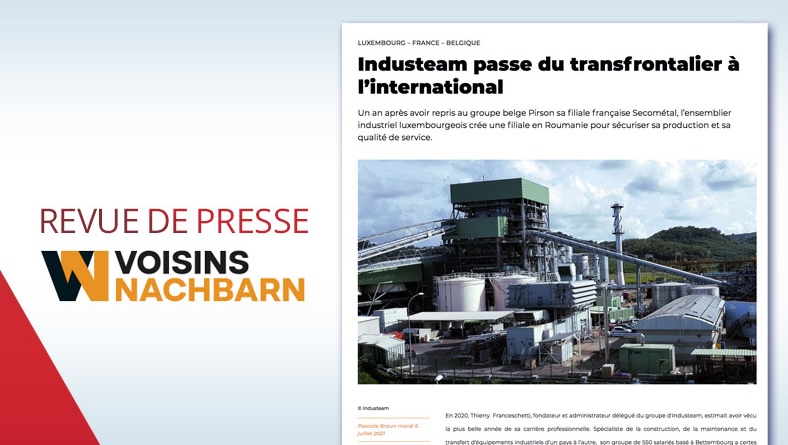
Excerpt from the article published on voisins-nachbarn.eu - Author: Pascale Braun.
Read the article on the voisins-nachbarn.eu website
In 2020, Thierry Franceschetti, founder and CEO of the Industeam group, considered it the best year of his professional career. Specializing in the construction, maintenance, and international relocation of industrial equipment, his 550-employee group based in Bettembourg did lose 20 million in revenue—compared to the 75 million euros in 2019—due to the pandemic. However, at the same time, it secured 30 million euros in new orders and acquired three companies from the Belgian group Pirson, including the French firm Sécométal.
2021 looks just as promising, as the group is finalizing the creation of Industeam East Europe, consisting of a 50-employee factory and a joint venture with Emsil, a Romanian machine-tool specialist (250 employees).
Juggling cultures
"In an industrial market facing shortages, this new entity will allow us to secure our production resources and lead times. For our new markets in the green energy sector, we need to have parts manufactured to specification and ensure maintenance and repair operations," explains Thierry Franceschetti.
Founded fifteen years ago by just two employees, Industeam attributes its growth to its cross-border approach, which taught it from the very beginning how to juggle different cultures, social and tax systems, and markets. Its first contract, won in 2006, involved moving the ArcelorMittal Luxembourg rolling mill from Dudelange to Ghent, Belgium. Initially specialized in the steel industry, the group diversified into the manufacturing sector, then into the automotive industry and nuclear maintenance, before setting its sights on renewable energies, notably by managing the transition to biomass for the Albioma power plant based in Réunion.
The Romanian asset
The Romanian presence is the result of fifteen years of operations in the country. Having arrived during the transfer of Romanian industrial equipment to Mexico, the company focused on building loyalty with, and subsequently recruiting, a team of about ten people employed by its subcontractors. It gradually integrated this workforce into its French and Luxembourgish teams, following a now well-established process. Accustomed to a minimum monthly wage of barely 450 euros, the Romanian mechanics, pipefitters, and welders are happy to be hired at the French minimum wage for projects in France, or at the Luxembourgish base salary—2,000 euros per month for a 40-hour week—for operations in Luxembourg or abroad. These wages then increase with seniority. For its part, Industeam finds in the Romanian workforce a level of mechanical skill, flexibility, and quality of service that is highly valued.